
The Truth About Canola Oil
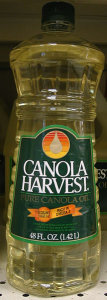 Many companies are selling canola oil as the "healthy" alternative, but canola oil is a *counterfeit oil made from genetically engineered rapeseed plants. Canola oil, in fact, was invented in 1976, and it wasn't merely the product of selective breeding, as its proponents contend. Its parent, rapeseed, was banned for food oils, because it attacks the heart to cause permanent degenerative lesions. Canola is not exactly the healthy choice either, and as mentioned earlier, it is officially an E.P.A. registered pesticide. What remains of canola oil (after cooking) is just another hydrogenated oil being pushed by the industry, solely for greed; and it will damage the cardiovascular system in time, like all such oils. Part of the word games used to deceive you about canola oil involve the fact that it is a healthy oil until it is actually heated. Then it undergoes a chemical transformation. So yes, canola is a healthy cooking oil provided that you do not actually cook your food in it. As long as it remains cold and inside its air-tight bottle -- it tests to be healthy! However, once heated, canola oil produces 1,3-Butadiene, benzene, acrolein, formaldehyde, and other related compounds which become infused into the foods being cooked.
Canola has been F.D.A. banned from infant formula because it stunts the growth, and there are likely other reasons not disclosed.
Canola oil is also noted to produce cancer causing toxic fumes when heated at much lower temperatures than are required to cause smoking by other oils, and of course, heating is its intended use. Rapeseed and canola oil fumes are the primary reason for the surprisingly high incidence of Asian lung cancers, despite tobacco smoking being a rarity. Canola fumes have been known to kill pet birds, and many readers will remember that pet parakeets were once used in coal mines to detect the presence of poison gases.
While we do not always see eye-to-eye with Dr. Joseph Mercola, we do respect him for having guts. He was the first to go against the collective grain to attack the deceptive canola industry, and it was right that he did. As reported by Dr. Mercola:
"Canola oil was developed from the rape seed, a member of the mustard family. Rape seed is unsuited to human consumption because it contains a very-long-chain fatty acid called erucic acid, which under some circumstances is associated with fibrotic heart lesions. It has a high sulphur content and goes rancid easily. Baked goods made with canola oil develop mold very quickly. During the deodorizing process, the omega-3 fatty acids of processed canola oil are transformed into the dangerous trans fatty acids, similar to those in margarine, and possibly more dangerous. A recent study indicates that 'heart healthy' canola oil actually creates a deficiency of vitamin E, a vitamin required for a healthy cardiovascular system. Other studies indicate that even low-erucic-acid canola oil causes heart lesions, particularly when the diet is low in saturated fat."
Which reminds me that one of the retail "vegetable" oils even boasted about having Vitamin E. Of course, it was the synthetic variant of Vitamin E, which actually does almost nothing; but in addition, becomes highly toxic whenever heated. It is important to remember that it was in a cooking oil. That made it so "healthy" after all, because the canola and soy were not healthy enough without it. I really had to wonder why they didn't simply add some paint thinner too -- which is technically very chemically similar to these oils when broken down by high heat.
To learn the painful details about the chemical engineering required to make canola oil supposedly fit for human consumption, see our previous article, The Bomb Shell Truth About Canola Oil.
Our strong recommendation is that you use cold pressed extra virgin olive oil for almost everything, or even pure butter. Cold pressed extra virgin olive oil is unchanged from God's hand. Sunflower oil (not to be confused with safflower) is a second best if it is unavailable. Use peanut oil for deep frying, because of its resistance to breaking down in high heat.
*edit, a word substitute
Hmmm. I haven't opened it yet, so I might just return my brand new bottle of an "E.P.A. registered pesticide" and get some sunflower or olive oil! :) I wonder in what other areas I've been bamboozled into thinking something is "healthier"?


